Everything You Need to Know About Risography


Risography was invented in Japan in the 1980s and is still a popular printing technique. In this blog, you can learn more about risograph printing.
Risography was invented in Japan in the 1980s and is still a popular printing technique. In this blog, you can learn more about risograph printing.
Did you know that…Risography embraces imperfection to fuel contemporary creativity?
You might be surprised to learn that one of the most popular digital printing techniques for comics, magazines, and artworks was invented in Asia just a little over forty years ago. The Risograph printer was developed in Japan in the 1980s and was first designed to provide offices and schools with a cheap way to produce high-volume photocopies and prints. However, it wasn’t long before the unique visual elements of risography made it a hit with artists and designers.
While it is by no means a precise printing technique, risography has a distinct style all of its own. Featuring bold, vibrant colourisation, mismatched images and startling textural elements, risography quickly became popular with artists, advertising executives, and creators of underground magazines and comic books.
Because of its wild style, risography has retained a cult following. Many digital printing businesses offer a range of Risograph printing services, and the technique is still used by independent publishers, artists, and authors.
What is Risography?
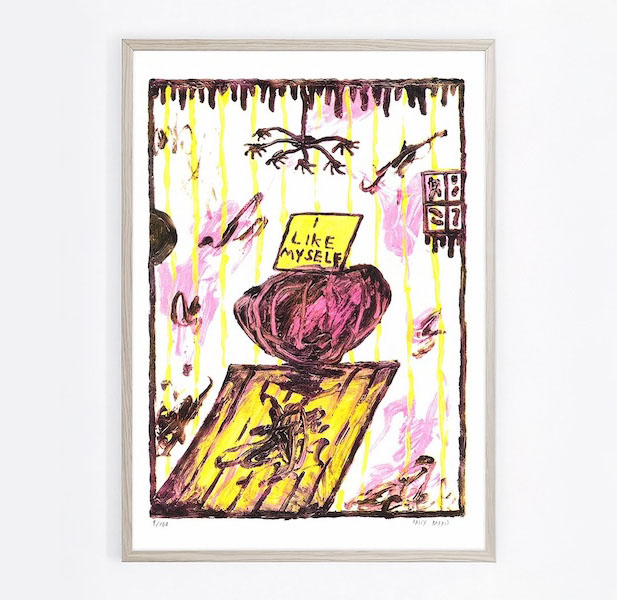
Souce : Daisy Parris for Ellipsis Prints
Risography originated in Japan in the mid-1980s. The Riso Kagaku Corporation, a printer and ink company, invented a digital duplicator known as the Risograph 007. A Risograph uses a unique printing technique that merges elements of photocopying and screen printing.
The Risograph 007 was truly a mash-up of analogue and digital technologies. A Risograph first creates a stencil, called a ‘master’. The master is wrapped around a drum filled with soy-based ink. As paper is fed into the Risograph as it passes underneath the drum. The machine presses ink through the stencil onto the paper.
Each separate colour requires a pass through the Risograph, much like the screen-printing process. As the colours are built up, the layers can become misaligned. This is what gives risography its quirky charm and its handmade feel.
Why did Risography become so popular?
Risography is a highly affordable, fast, and environmentally friendly method of printing. Although it is not anywhere near as accurate as other methods, its off-centre designs add to its appeal. A Risograph is environmentally friendly as it uses no water, little energy, and each master is capable of printing up to 8,000 copies.
Originally, the Riso Kagaku Corporation intended their invention to be used for cheap printing for schools, businesses and organisations. However, the lack of consistency in the printing results and the rise of more advanced printing and photocopying technology meant that the Risograph soon fell out of favour for corporate and educational use.
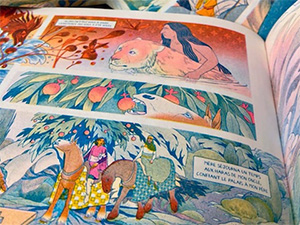 Inside page from the comic strip ‘La Manticore’ by Mayeul Vigouroux, published by Quintal, 2022
Risography, however, was by no means dead. The inaccurate and unpredictable printing results proved to be a hit with artists and underground publishers. The inherent imperfections in risography came to be viewed as charming and authentic rather than messy and sloppy.
The layering method and the constraints of the limited colour palette of a Risograph machine attracted artists who were keen to experiment with its eye-catching visuals. Every Risograph print is unique, so risography is a wonderful printing technique for artists, despite the inconsistency of its output.
The low cost of risography also made it attractive to people who wanted to self-publish magazines, posters, comics, and books. Risograph printers made it possible for authors, artists, and fringe groups to create visually interesting small to medium print runs without spending a lot of money.
How is Risography used today?
The distinct, slightly blurred, and highly vibrant colourisations of risography mean that the technique is still favoured by many artists and publishers today. Contemporary artists such as Tianying Yu, Daria Tessler, Shun Sasaki, and Vincent Patterson all still use risography techniques in their work. These artists create striking, inventive and playful works by embracing the inherent imperfections of risography.
There is even a group of artists dedicated to the use of risography. Riso Sur Mer is a creative collective formed by Mari Campistron, Élise Rigollet, Inès Gradot, Josephine Ohl, and Margaux Bigou. These artists found they shared a common passion for risograph printing's bright colours and quirky textural qualities.
Many fashion designers prefer to use Risograph printing as it enables them to create a number of unique garments from one stencil. Although it provides a similar result, risography is faster, requires less cleaning up and is more environmentally friendly than screen printing.
Publishers of short-run art books and underground magazines still use risography. The affordability, fast turnaround, and distinctive visual appeal make it a viable option for smaller publishers.
Risograph printing is a unique technique that stands out in our digital world. Maybe it's time you tried it!