
Edward Burra – Ithell Colquhoun Exhibition

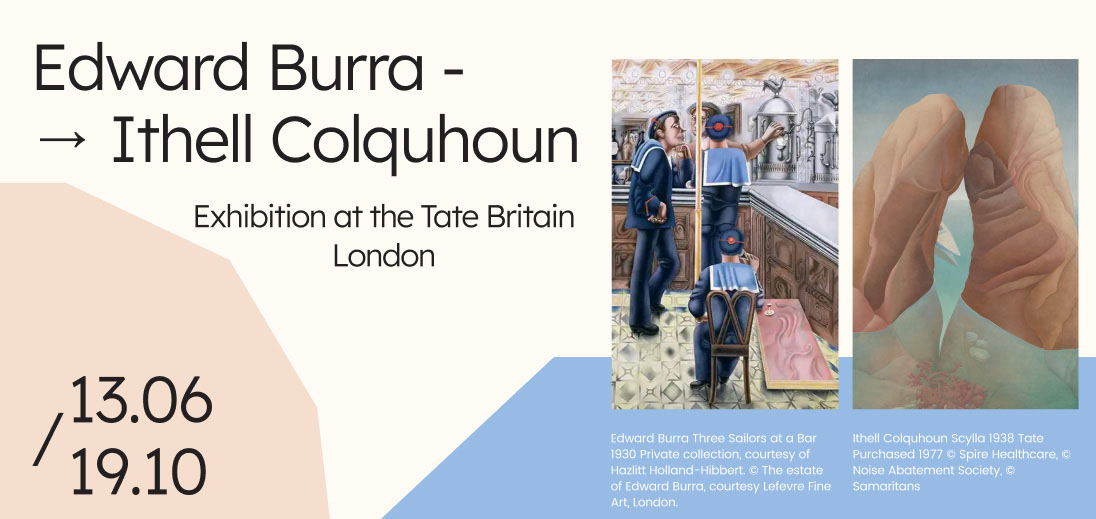
Edward Burra and Ithell Colquhoun are two of Britain’s most important surrealist artists. An exhibition is now on show at the Tate Britain.
Edward Burra and Ithell Colquhoun are two of Britain’s most important surrealist artists. An exhibition is now on show at the Tate Britain.
Must-see show: Edward Burra – Ithell Colquhoun Exhibition at the Tate Britain, London
When most casual art lovers think of surrealism, they’ll more than likely come up with the names of European artists such as André Breton, Max Ernst, or Salvador Dalí. But despite the surrealist movement’s originating in France, it was a truly international phenomenon, and Britain played an important role in its development.
Two of the most respected British surrealist artists were Edward Burra and Ithell Colquhoun. Provocative, strange, and satirical, their work explored a broad range of themes. Both artists sought to bring to light sensitive or taboo topics such as sexuality, the unconscious, the occult, marginalised figures, as well as political issues.
From the 13th of June to the 19th of October 2025, visitors to the Tate Britain art gallery in London can see a parallel exhibition of the works of Burra and Colquhoun. This is a rare chance to see Edward Burra’s scenes of the underground queer culture of the 1920s. The exhibition also represents the first major showcase of the works of Ithell Colquhoun.
Discover the works of two major British surrealist artists
While Burra and Colquhoun had remarkably different styles, they are generally both associated with surrealism. Burra was considered a social surrealist who depicted real-world scenes via dream-like images. Colquhoun was a formal member of the British Surrealist Group who was obsessed with exploring unconscious and mystical themes in her work.
Despite their differences in style and intention, Burra and Colquhoun do have elements in common. Both artists created works with surreal, dreamlike, or hallucinatory elements. And both artists primarily choose to use paper as a medium instead of canvas.
Burra almost exclusively used watercolour on paper. Colquhoun often used watercolour, gouache, and automatic techniques on paper.
Edward Burra – Surreal historian of the 1920s queer scene
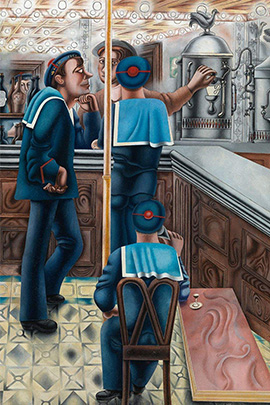 Edward-Burra Three Sailors at a Bar 1930. Private collection, courtesy of Hazlitt Holland-Hibbert.
Source : www.tate.org.uk
Burra was celebrated for his daring use of traditional watercolour methods. By creating vivid washes, Burra depicted striking and often disquieting scenes based on his real life experiences in the queer underworld during the so-called ‘Roaring Twenties’ period. His work is bold, vivid, and shows the powerful expressive capabilities of paper as a medium.
Burra suffered from severe rheumatoid arthritis from a young age. This debilitating affliction impeded his movements and forced him to forgo the traditional method of working with a canvas on an easel. Burra chose to paint with watercolours on paper resting on a table top as it allowed him ease of movement and gave him better control over the smaller, detailed aspects of his paintings.
The exhibition at the Tate Britain is the first time in 40 years that so many of Burra’s works have been shown in London. The paintings on display are primarily on paper and depict Burra’s experiences in the queer scenes of Britain and France during the 1920s. The paintings also reflect his life during the Second World War, the Spanish Civil War, and throughout the Industrial Revolution. Over 80 artworks are included in the exhibition.
Ithell Colquhoun – An innovative British surrealist radical
Often considered to be one of the most unheralded female surrealist artists, Ithell Colquhoun is nonetheless a major figure in art history. She was a dedicated surrealist artist and an accomplished writer who produced fiercely original and compelling works.
Throughout the 1930s and 1940s, Colquhoun used automatism and techniques such as decalcomania, a painting technique used to create spontaneous, abstract textures and patterns. She employed these types of techniques to produce intricate, dreamlike imagery on paper.
Much of Colquhoun’s work centres on her fascination with the occult and the unconscious mind. Some art historians believe that it was her obsession with the occult that led to her being reportedly ousted from the British Surrealists. However, others point to Colquhoun’s fiercely independent nature as the reason for her expulsion.
Visitors to the Edward Burra and Ithell Colquhoun exhibition should look out for her Tarot deck interpretation, a bold piece that shows her considerable talent at combining her artistic flair with her spiritual preoccupations.
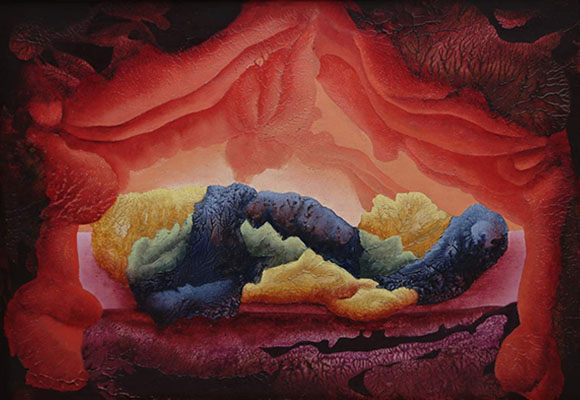 Ithell Colquhoun Alcove 1946 Private Collection.
Source : www.tate.org.uk
Two exhibitions for the price of one ticket
The Edward Burra and Ithell Colquhoun exhibition at Tate Britain is a unique opportunity to experience a wide selection of exciting and provocative artworks. Visitors can access both exhibitions on one ticket.
This unprecedented exhibition highlights the inventive uses of paper and associated materials by two of Britain’s most innovative and yet still relatively unknown artists. The exhibition perfectly exemplifies the principles of Creative Power by Antalis and our commitment to championing the artistic exploration of paper media.