
Paper Was Once as Precious as Silk

Paper is now seen as an everyday item. But in the past, paper was a true luxury item. Learn more about when paper was as precious as silk.
Paper is now seen as an everyday item. But in the past, paper was a true luxury item. Learn more about when paper was as precious as silk.
Did you know that… paper was once as precious as silk?
It’s easy to dismiss paper as a common, everyday item without an intrinsically high value. But there was a time in history when paper was indeed a highly valuable and much sought-after material. In fact, when paper was first introduced to Europe, it was considered a luxury material that was almost as rare and valuable as silk.
In this article, we explore the reasons why paper was so valuable in the time before industrial production and take a look at the continued legacy of high-grade paper. After reading the facts below, you might just start to think twice about what the real worth of paper is!
The remarkable origins of paper
Since the very dawn of our existence, humans have communicated ideas via pictograms, ideograms, and writing. But for a very large period of humanity’s development, we simply did not have a suitable material for drawing or writing. Before the development of paper, people had to carve symbols into stone, wood, and clay. Examples include Roman stone tablets or the clay tablets used by the ancient Mesopotamians.
Needless to say, the process of writing on stone, clay, or wood was arduous and time-consuming. Eventually, materials made from plant or animal matter became popular throughout the world for drawing or writing. While a distinct improvement upon chiselling rock, carving wood, or forming clay, these early materials were still difficult and expensive to produce.
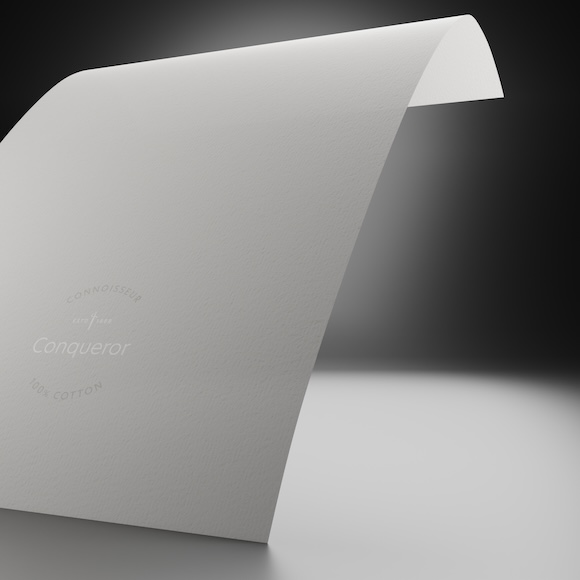 Elegant white textured paper with subtle watermark branding
The breakthrough originated in ancient China, somewhere around ,2000 years ago. The invention of paper is largely credited to a Chinese court official known as Cai Lun. Sometime around 105 CE, Cai Lun developed a process of turning a slurry of bark, cloth rags, and hemp into thin sheets by spreading it on flat screens and drying it. The result was an ultra-lightweight and flexible material that could hold ink and was quicker and cheaper to produce than the alternatives.
Throughout the 5th to the 8th centuries, paper slowly made its way from China to Vietnam, Korea, Japan, and then into India and the Islamic world. Europeans, however, were not to experience the wonders of paper until the 11th century. And when they did, not everyone could afford it.
Why paper was once as valuable as silk
Before paper arrived on the continent’s shores, Europeans used materials derived from animal skins such as parchment and vellum. These materials were uneven, hard to store, difficult to write on, and labour-intensive to produce.
Paper came to Europe via the Islamic conquests of Sicily and parts of Spain. Unfortunately, the Europeans weren’t exactly quick to discover the usefulness of this new material. In 1221, the Holy Roman Emperor Frederick II even went as far as to ban paper from being used for public documents.
Then in the 12th century, papermakers in Italy discovered the technique of using linen and hemp to produce paper. Despite this development, making paper still required skilled labour and special materials like linen rags. Rags become so valuable in and of themselves that some European countries prohibited the international rag trade. Paper making also required water-powered mills, which were hugely expensive to build and operate.
Paper became a highly luxurious item, on a par with silk, another valuable and difficult to produce material. As a result, paper was mostly used by the Church, royalty, and the wealthy. Even for those in high places, paper was not a disposable item.
Paper was highly valued by scribes, artists, and printers, who used it to create ornate manuscripts, document important legal and governmental texts, and reproduce detailed artworks. Until the 18th century, people with access to paper had to repeatedly reuse the same sheet. The writer Jane Austen is a well-known example of this practice.
 Curved white paper creating flowing sculptural forms
From a luxury item to an everyday essential
In the 19th century, paper production expanded significantly, enabling it to be manufactured on a larger scale and at much lower costs. As a result, paper transitioned from a luxury item to an affordable, everyday product. With easier access to paper, writers, artists, and researchers were able to innovate like never before.
The fine art and specialty papers from Antalis uphold the legacy of paper as a tool and a symbol of craftsmanship. The Antalis collections feature beautiful, high-quality paper with textured surfaces, cotton fibres, and deckled edges. These tactile and attractive papers evoke the artistry of handmade sheets from the past.