
Did you know that…Origami has a fascinating history

Origami has a fascinating history and is still used by artists today to create stunning works. Antalis looks at the development of this unique art form.
Origami has a fascinating history and is still used by artists today to create stunning works. Antalis looks at the development of this unique art form.
Did you know that…Origami has a fascinating history – and is still used by artists today
The ancient art of origami seems almost like magic. In the hands of a talented practitioner, a single piece of ordinary paper can be folded and refolded to slowly transform into an intricate design. Complex shapes and realistic depictions of birds, animals and flowers spring into being from a non-descript two-dimensional surface.
Throughout the centuries, origami has been used for ceremonial purposes, for entertainment, and has influenced artists, designers, architects, scientists, and engineers. At its core, however, the timeless practice of origami is a celebration of creativity, patience, and a display of the limitless potential of paper.
The fascinating history of Origami
The art of papermaking is believed to have been brought to Japan by Chinese Buddhist monks around the year 610. For centuries paper was considered a luxury in Japan and was available only to the select few. However, Japan experienced a long era of stability and economic growth throughout the Edo period of 1603 to 1867. During this time, the practice of origami became widespread.
The word ‘origami’ consists of two Japanese words: ‘ori’ for fold and ‘gami’, which means paper. Originally, origami was known as ‘orikata’ or folded shapes. Orikata was practised by aristocrats and high-ranking military figures. It involved using folded paper for ceremonial purposes. As the art of folding paper gained in popularity, the term origami was adopted.
During the eighteenth century, the art of Japanese origami was heavily influenced by Western ideas, including European napkin folding and pedagogical paper folding techniques taught in German kindergartens.
In 1860, Japan opened its borders and culture to the world which saw the art of origami spread rapidly throughout the globe. Interest in origami in the Western world rose after World War II as the Japanese folktale of Sadako Sasaki and the Thousand Paper Cranes became widely known.
Exhibitions throughout Europe by the Japanese master Akira Yoshizawa and the opening of the Origami Center of America in New York by Lillian Oppenheimer further fuelled interest in origami. By the 1970s and the 1980s, origami was recognised worldwide both as a form of entertainment and as an artistic practice.
The use of Origami in the art world
Several notable artists have elevated origami from a recreational and ceremonial practice to high art:
Akira Yoshizawa (Japan): The creation of modern origami techniques is widely credited to Akira Yoshizawa (1911-2005). Yoshizawa rejected traditional cutting methods and developed a wet folding technique that produced more natural, softer lines. The author of various books on origami and the creator of more than 50,000 models, Yoshizawa is revered as the grandmaster of modern origami.
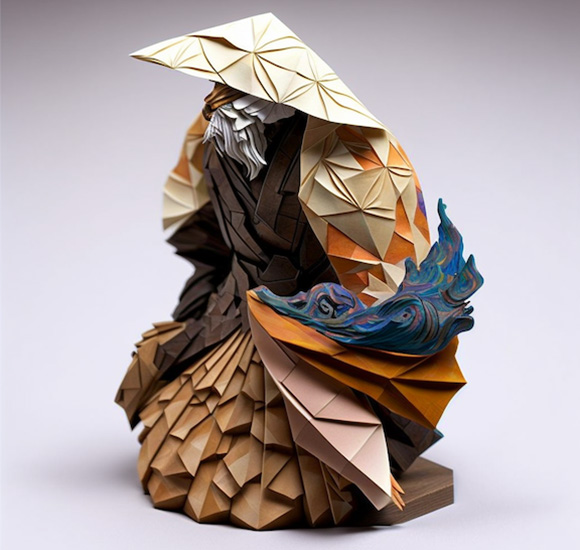 Yoshizawa, the master of Origami, the art of Japanese paper folding
Source : 14 mars 2023 / Par M. D.
Eric Joisel (France): One of the most influential European origami practitioners was the French artist Eric Joisel (1956-2010). A trained sculptor turned master of figurative origami, Joisel crafted remarkably expressive paper sculptures, which often took over 100 hours to complete. His origami hedgehog was folded from a single sheet of paper and took almost six years to complete.
Drawing inspiration from mythical and fantastical beings as well as nature and the human form, Joisel said of origami “When people ask how long it takes me to make a sculpture I say ’35 years’, because that is how long it’s taken me to get to this level.”
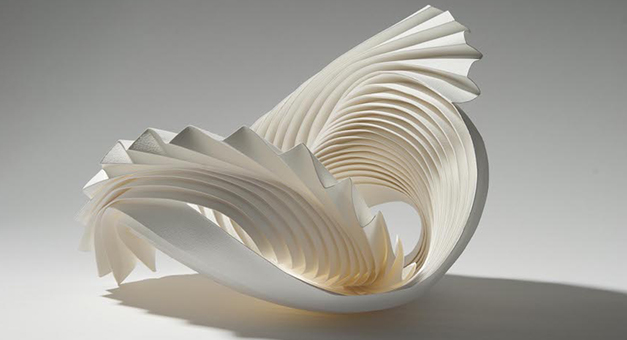
Richard Sweeney (UK): Born in Huddersfield, England in 1984, Richard Sweeney also trained as a sculptor. He is now a major artist and lauded as one of the most inventive and creative origamists in the world. Inspired by organic patterns, Sweeney manipulates paper into flowing, elegant works of art.
How Origami has influenced architecture and design
Origami has not only inspired artists. The practice has also changed how engineers, architects and designers approach their craft. Origami’s geometric precisions are used to develop complex, visually striking architectural forms, engineering breakthroughs, and striking garments.
Dutch architect Lars Spuybroek incorporates origami-inspired folds to create fluid architectural spaces. The Miura Fold, developed by Koryo Miura in Japan, is an origami-based technique used in deployable solar panels for satellites, including NASA projects.
Renowned Japanese designer Issey Miyake applies origami principles to craft sculptural garments that blend art with functionality.
Companies are using origami-inspired designs to reduce waste and present products in more innovative packaging.