
AI is revolutionising how art is created and experienced

Discover how revolutionary new AI technologies are changing how we experience and create art.
Discover how revolutionary new AI technologies are changing how we experience and create art.
Did you know that … AI is revolutionising the way art is created and experienced?
The artificial intelligence (AI) revolution is well and truly now upon us. Humanity is entering a new era of technological innovation and development the likes of which we have never seen before. As the evolution of AI and machine learning rapidly advances, these technologies are gradually being embedded into every part of our lives. From how we work to how we spend our leisure time - and how we create and experience art.
While many artists fear that AI will replace them, others have embraced this new technology by integrating AI elements into artworks and galleries. AI allows artists to experiment and discover new ways of bringing their concepts to life.
Using AI to push the boundaries of art
Historically, artists have always embraced new technologies and mindsets. As we enter the age of AI, creators may seek to use powerful new tools instead of pushing back against the inevitable march of technology. By doing so, creators could usher in a new era of artistic innovation that combines human creativity and ingenuity with cutting-edge technology. Platforms like DALL-E and MidJourney allow artists to create artworks that combine the spontaneity of AI with the authenticity of the human artistic vision.
Indeed, there are a number of contemporary artists who now view AI not as a competitor but rather as a valuable collaborator.
Refik Anadol from Istanbul, Turkey uses AI to create large-scale projections and architectural interventions. He takes data as a primary material and transforms it via algorithms and AI tools into stunning displays of colour and form.
The American artist Ian Cheng creates immersive digital simulations and environments using AI technology. With a background in both cognitive science and the visual arts, Cheng creates virtual ecosystems with characters and features that are programmed to evolve over time. The artist’s works display complex behaviours and interactions that mimic life itself.
Stephanie Dinkins is another American artist who is choosing to incorporate AI into her works. She uses AI to create platforms that encourage viewers to enter into dialogues about art, technology, gender, race, and the human ageing process.
One of her recent works, Conversations with Bina48, involved a series of filmed conversations between the artist and a highly sophisticated autonomous social robot. The aim was to unveil uncovered aspects about the human condition and the interactions between a human and a robot.
 Hallucinations of machines - Renaissance Dreams (2022)
Source : ©Shutterstock
Re-inventing artistic techniques and processes with AI
There are a myriad of ways in which AI can help artists produce imaginative works. One of the most overlooked benefits of AI is that it can streamline the process of creating art. AI can be used to perform repetitive tasks which enables creators to focus more on conceptualization and storytelling.
AI-powered tools can sometimes automate processes involved in creating digital artworks such as image resizing, colour correction, and background removal.
AI can also be used for pattern-generation purposes, freeing artists from the painstaking and repetitive process of creating highly detailed artwork.
There are also platforms like RunwayML which provide pre-trained machine learning models for image and video processing. By using these types of tools, artists can explore new visual styles and automate routine tasks.
AI can help artists research new concepts as it can access and process massive datasets of art history. In this way, AI algorithms can reveal hidden relationships and patterns that can inspire artists to create groundbreaking works.
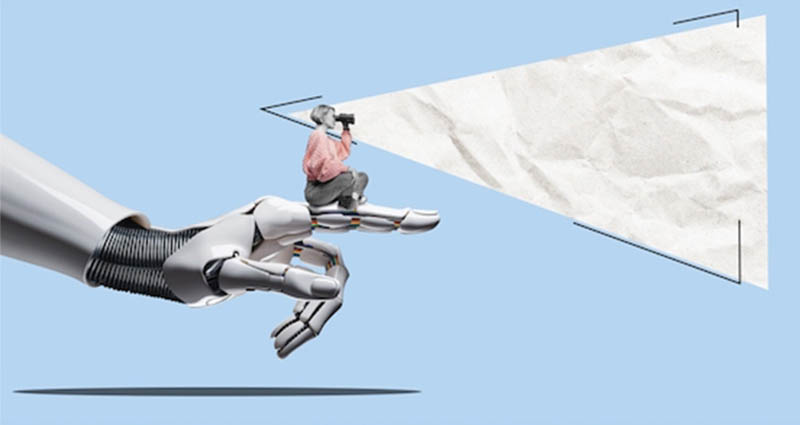 Cyber-IA hand shows the businesswoman with binoculars.
Source : ©Shutterstock
AI is helping to revive our artistic heritage
New technologies are also enabling us to deeply explore the methods and practices of past masters of the art world like Vincent van Gogh and Leonardo da Vinci.
The Gustav Klimt – Pigment & Pixel exhibition at the Belvedere Museum in Vienna is a wonderful example of the use of AI to revive revered works. This exhibition reconstructs Klimt’s Faculty Paintings, which were lost to fire during the end of World War II. An AI algorithm analysed Klimt’s known colour palette and a series of black-and-white photos of the works to recreate them in vivid detail.
AI can also provide art lovers with a more immersive experience with both the artworks and the artists themselves. Artists and galleries can now create immersive and interactive environments that respond to viewers' actions and questions.
By choosing to incorporate AI into the art world, we could thus deepen our understanding and enjoyment of art and reshape the boundaries of artistic expression.