
Making art can boost your brainpower

Art doesn’t just delight and inspire us, it can also help make us feel more focused, decrease our stress levels, and even make us smarter!
Art doesn’t just delight and inspire us, it can also help make us feel more focused, decrease our stress levels, and even make us smarter!
Did you know that…making art can boost your brainpower?
Neuroscience is proving that making art has a massive impact on our ability to think and feel better about ourselves and the world around us. Research has shown that making art changes the patterns of our brain waves and affects the chemicals that drive our emotions1.
No matter whether you’re an accomplished artist, an enthusiastic beginner, or simply an art lover, there are major benefits to be had.
Making art gives our brains a boost
Any kind of creative activity engages our problem-solving abilities and pushes us to see the world in new ways. This helps develop neuroplasticity, the brain’s ability to make and organize synaptic connections. As your brain gets faster at making these connections, your cognitive abilities and problem-solving skills increase.
Making art makes us feel good
Studies show that when we create a piece of art, blood rushes to the brain’s medial prefrontal cortex, the reward center of our brain. Making art also sends dopamine flooding through our nervous system. The increase of blood to the medial prefrontal cortex and higher dopamine levels elevate our moods. This effect is one of the reasons why art therapy is used for people who have undergone traumatic experiences or are suffering from depression or anxiety5.
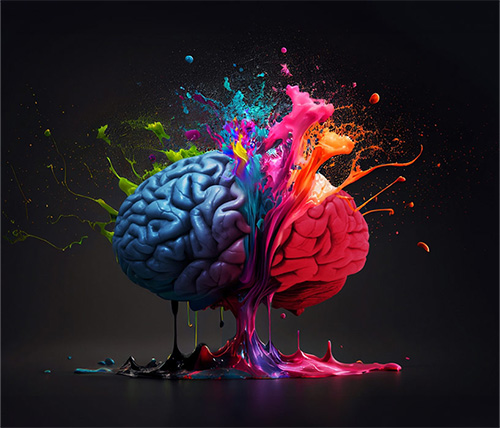
The brain of creative art explodes with paint chips on a black background, concept idea. Credit : Shuttertstock
Making art lowers our stress levels
Cortisol is the hormone that regulates our stress levels. If we have too much cortisol, we feel stressed out, which negatively impacts our physical and mental health. Out of 37 studies on how art reduces stress, 30 showed reduced stress levels in test subjects. Researchers looking into the link between making art and stress have reported that creating art reduces stress in up to 90% of people.
A study from Drexel University’s College of Nursing and Health Professions showed that 75% of people experienced lower cortisol levels after creating art for just 45 minutes. The test subjects ranged from 18-59 years of age and had various skill levels.
Although younger subjects experienced higher cortisol reductions, the reduction in cortisol did not correlate to how experienced the person was as an artist. Despite the fact that 25% of people had higher cortisol levels, this was not seen as a bad outcome. The scientists believe it simply shows that the subjects were actively engaged in the artistic activity. None of the subjects reported the experience to be a negative one.
Making art builds resilience and gives us hope
Some researchers now believe that art has played a major role in our evolution as it helps us to prepare for and navigate problems.
The act of making art requires our brains to solve problems, envision possible outcomes, make decisions and attribute meaning. This enhances the predictive abilities of our brains and helps us to build resilience in our daily lives.
Creating art has numerous positive benefits for our moods and our brains. It doesn’t matter what your skill level or age is or what type of art you are making. Even the act of looking at art can boost our learning abilities and improve our mental health.
The science is clear: making art makes you smarter and happier. There’s no reason not to start drawing, painting, sculpting, dancing, making music, or writing right away!