
Highlighting customer cases: High-performance sustainable solutions

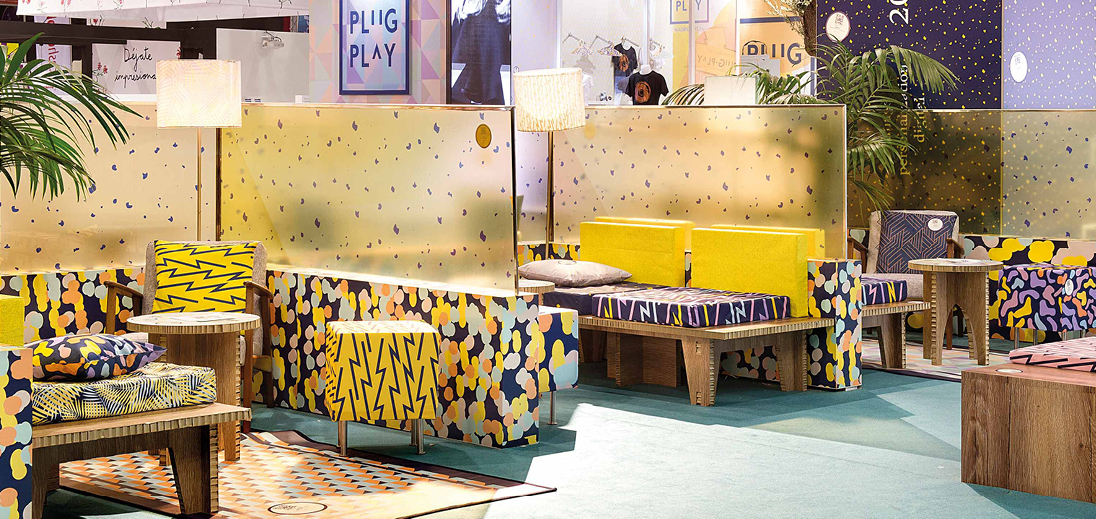
Luxury visual impact and sustainability are no longer incompatible. Antalis helps agencies meet strict ESG standards using premium eco-designed alternatives like Lumex-A and Xanita Board.
Luxury visual impact and sustainability are no longer incompatible. Antalis helps agencies meet strict ESG standards using premium eco-designed alternatives like Lumex-A and Xanita Board.
I. The new “Sustainable Premium” standard
Sustainability expectations within the visual communication industry have evolved dramatically over the past few years. Major international brands, particularly in the entertainment and technology sectors, now impose strict environmental specifications for retail campaigns, event displays and signage systems.
Companies such as Sony and Paramount are increasingly integrating ESG criteria into every aspect of their communication projects. Materials are scrutinised not only for their aesthetic qualities, but also for recyclability, carbon footprint and end-of-life management.
Historically, premium visual finishes have relied on materials that are difficult to recycle. Acrylic sheets, foam boards and plastic honeycomb structures became industry standards because they offered transparency, rigidity and high-end visual appeal. However, these substrates are often energy-intensive to manufacture and problematic at the end of their life cycle.
This changing landscape has created a new challenge for agencies and print professionals. How can brands maintain a premium visual experience while drastically reducing environmental impact?
This is precisely where Antalis comes in. Rather than asking brands to compromise on quality, Antalis promotes a new generation of eco-designed materials capable of delivering equivalent, or even superior, aesthetic results.
II. The Embello case: meeting the challenge of industry giants
A strong example of this transformation can be seen in the work of Embello, a British agency specialising in print and branding, highly renowned for its high-quality in-house production.
Embello works with globally recognised clients, including Sony and Paramount, where visual impact is critical. Campaigns for the entertainment industry demand vibrant colours, flawless finishes, large-scale structures and highly immersive retail or event environments.
At the same time, these clients are actively pursuing decarbonisation strategies and more sustainable procurement practices.
Rather than relying on “basic recycled” substrates that might compromise aesthetics, Embello partnered with Antalis to identify high-performance alternatives capable of replacing conventional industry materials without affecting the final visual experience.
Two products proved particularly effective:
- Lumex-A to replace transparency.
- Xanita Board for rigid structures.
This approach demonstrates an important evolution in eco-design: sustainability is no longer associated with compromise or “lower grade” visuals. Instead, sustainable materials are becoming premium options.
III. Product focus: Lumex-A, transparency without compromise
The Acrylic (PMMA) Problem
Acrylic (PMMA or plexiglass) has long been associated with luxury display design thanks to its crystal-clear transparency and glossy finish. Yet its environmental profile is increasingly being questioned. Its manufacturing process is highly energy-intensive, and acrylic remains difficult to recycle effectively at scale. In many cases, end-of-life acrylic still ends up in landfill or incineration streams.
The Lumex-A Solution
Antalis offers an innovative substitute through the Lumex range.
Lumex-A is a transparent thermoplastic polyester sheet made from A-PET that excels in both flat and curved applications. It combines crystal-clear transparency, high print quality, remarkable impact resistance and exceptional recyclability.
Most importantly, PET benefits from a highly established recycling infrastructure worldwide, making Lumex-A a genuinely circular alternative.
Premium visual rendering
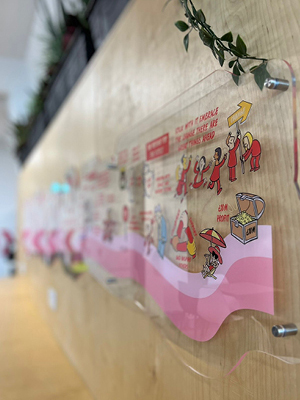
Another example shows Lumex-A used for sophisticated office signage and timeline graphics mounted onto wooden surfaces. Its precise cutting capabilities allow for elegant installations easier to handle than glass or thick acrylic sheets. The result is lightweight, safe, and highly visually impactful.
These examples show that recyclable materials can meet the highest design expectations without sacrificing elegance or technical precision.
IV. Product focus: Xanita Board, ultra-resistant lightness
The Problem with Traditional Boards
Large event structures and retail displays have traditionally relied on plastic honeycomb boards or PVC/polyurethane foam panels. Although effective, these materials are difficult to recycle and contribute significantly to exhibition waste.
The Xanita Board Solution
Antalis proposes a radically different approach with Xanita Board.
Xanita is an engineered fibreboard whose closed-cell core is made from recycled cardboard fibres. Its technical characteristics are particularly impressive: ultra-lightweight construction, exceptional structural strength, zero VOC emissions and 100% repulpable. Once the campaign is over, it can be recycled with standard paper and card recycling streams.
Unlike conventional rigid boards, Xanita combines sustainability with genuine structural performance.
Ideal for entertainment and retail environments
For brands like Sony and Paramount, Xanita Board is perfectly suited to large 3D point-of-sale displays, movie set constructions, temporary partitions, exhibition structures, and oversized retail installations.
Its lightweight nature simplifies installation and transportation, while its structural rigidity allows agencies to build complex environments without relying on plastic-heavy systems.
At the end of the campaign, the material can simply be disposed of through standard paper recycling channels, which is a major advantage for reducing exhibition waste.
V. Eco-design as a competitive advantage
The experience of Embello demonstrates a broader industry reality: sustainable materials are no longer niche alternatives. They are becoming strategic assets.
By integrating solutions such as Lumex-A and Xanita Board, agencies can comply with increasingly strict ESG requirements, reduce environmental impact, strengthen relationships with global clients and maintain premium visual standards.
Sustainability, therefore, becomes not just an environmental necessity but a powerful competitive differentiator.
- To support this transition, Antalis provides practical tools such as the Green Star System™, which helps identify highly recyclable and environmentally responsible materials from the outset of a project.
- Professionals can also explore sustainable substrates directly through the SwitchEco Box, allowing them to physically test alternatives and validate performance before production.