The Sustainability Glossary: Demystifying complex industry terms


Sustainability starts with understanding. This glossary helps visual communication professionals decode key terms and turn complex concepts into practical, eco-responsible choices.
Sustainability starts with understanding. This glossary helps visual communication professionals decode key terms and turn complex concepts into practical, eco-responsible choices.
I. Why is this glossary essential today?
Sustainability is no longer optional in the visual communication industry. Brands, agencies and event organisers are under increasing pressure to meet CSR and ESG standards, reduce environmental impact and demonstrate transparency across their supply chains.
Yet, while expectations rise, clarity often lags. Terms such as bio-based, recyclable, carbon offset or PVC-free are widely used, but not always fully understood. For buyers and agencies, this abundance of technical vocabulary can create confusion and lead to inconsistent or even counterproductive decisions.
This is precisely where Antalis takes a clear position: sustainability should be actionable. Simplifying terminology is not about oversimplification; it is about enabling professionals to make informed, technically sound choices.
Each term in the sustainability lexicon corresponds to a real material, a measurable performance, and a concrete application. Understanding the vocabulary is, therefore, the first step toward implementing effective eco-responsible strategies.
II. Recycled vs. Recyclable: The subtle (but crucial) difference
One of the most common misunderstandings concerns the difference between Recycled and Recyclable.
“Recycled”: the product’s past
A recycled product is made from waste materials reintroduced into the production cycle – either post-consumer (after use) or post-industrial (production scraps). This approach reduces the need for virgin raw materials and lowers environmental impact at the sourcing stage.
“Recyclable”: the product’s future
A recyclable product is one that can be collected, sorted and transformed into a new raw material at the end of its useful life. However, recyclability depends not only on technical properties but also on local infrastructure. A product may be theoretically recyclable but practically unrecycled if no collection or processing system exists.
Product focus: Lumex PET sheets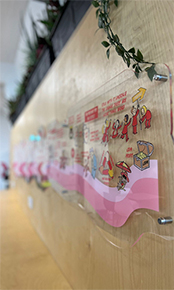
A strong example is the Lumex range. These transparent sheets, made from A-PET or PETG, combine high print performance with a key advantage: PET is one of the most widely recycled plastics globally. This makes Lumex a relevant alternative to more complex plastics that are difficult to process at end-of-life.
By choosing such materials, professionals align both the past (recycled content) and the future (recyclability) of their products.
III. The “PVC-Free” imperative
The challenge of PVC
Polyvinyl chloride (PVC) has long been the dominant material in large-format printing, used for banners, adhesive films and signage. Its success is due to its durability, flexibility and cost-effectiveness.
However, PVC presents significant environmental challenges. It is difficult to recycle cleanly and can release harmful substances when incinerated. As a result, many events and brands now require PVC-free solutions.
What “PVC-Free” really means
PVC-free materials rely on alternative substrates such as polypropylene (PP), polyester or paper, designed to deliver comparable mechanical performance without the associated environmental drawbacks.
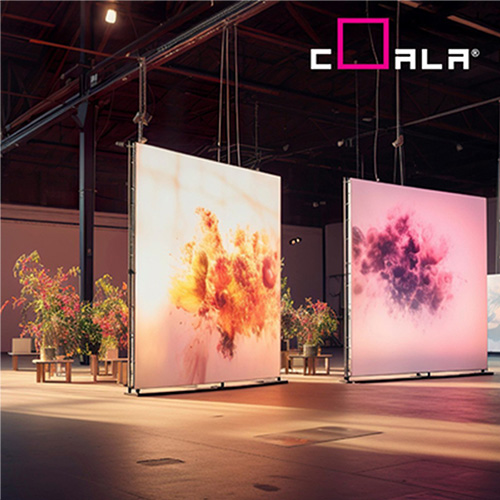
Product focus: Coala Textile Backlit City
A flagship example is the Coala Textile range. This 100% polyester textile is guaranteed PVC-free and specifically engineered for visual communication applications.
It offers:
- Excellent tensile strength for large-format displays
- A tight weave structure ideal for backlit applications
- High-quality print rendering without plastic glare
In practice, Coala Textile proves that eliminating PVC does not mean compromising on visual impact or technical performance.
IV. Eco-design: Thinking globally, from factory to end-of-life
What is eco-design?
Eco-design is defined by ADEME[1] as a preventive approach aimed at reducing environmental impact throughout a product’s lifecycle, from raw material extraction to end-of-life. This approach shifts the focus from isolated improvements to a global optimisation strategy.
[1] French agency for environment and energy transition
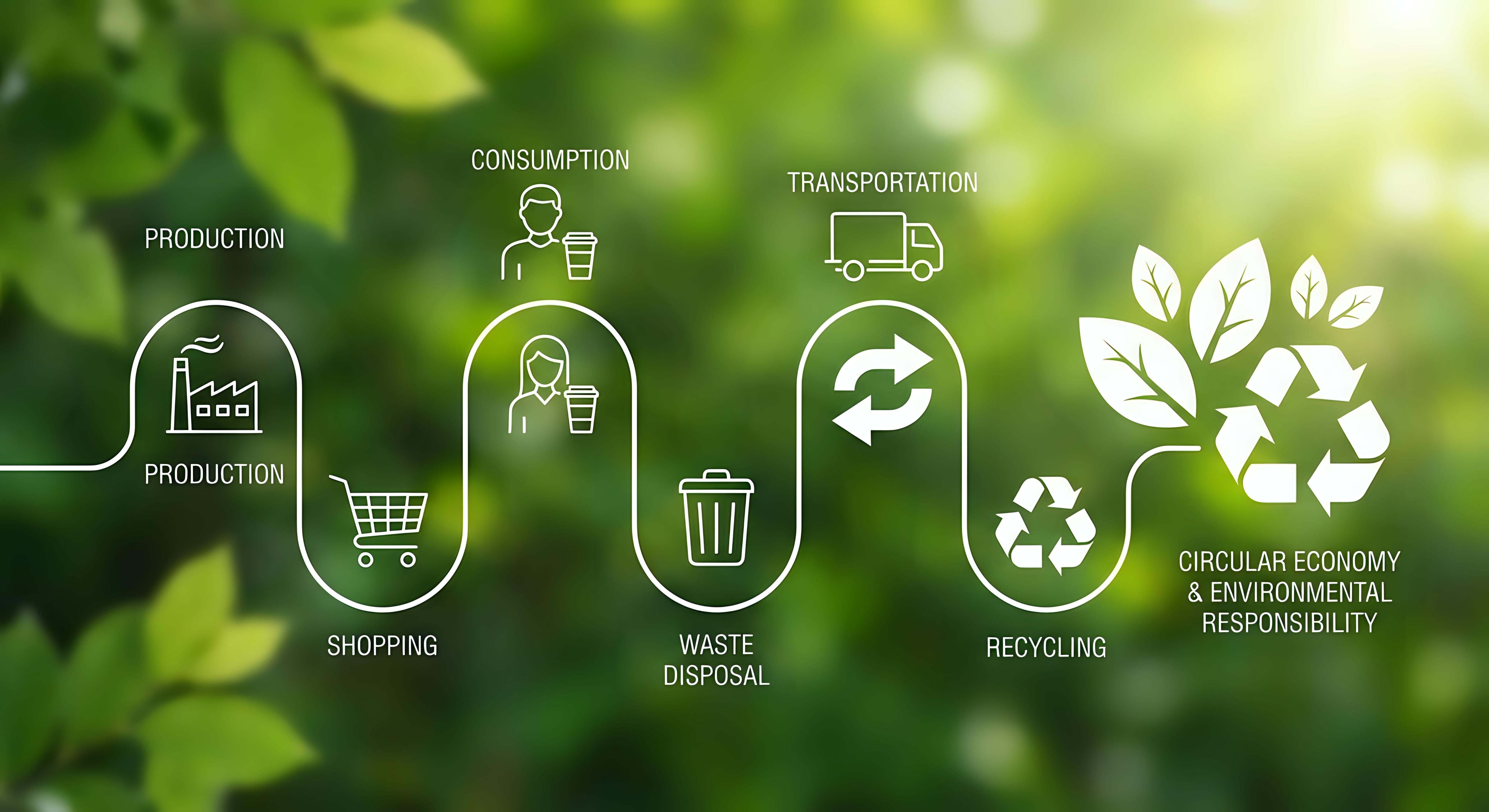
From design to end-of-life: the Antalis approach
1. Smarter material selection
Two key tools support eco-design decisions:
- SwitchGreen Box
A hands-on sampling tool that allows professionals to compare eco-responsible alternatives to traditional materials, facilitating the transition away from PVC. - Green Star System™
A transparent rating system (0 to 5 stars) based on circular economy criteria such as recyclability, recycled content and renewability.
Together, these tools transform abstract sustainability goals into clear, measurable decisions.
2. Printing and logistics optimisation
Eco-design also extends to production and logistics:
- Water-based inks significantly reduce volatile organic compounds (VOCs), improving environmental and workplace conditions.
- Textile materials are lighter, foldable and compact, unlike rigid PVC panels or heavy banners. This reduces transport volume and associated CO₂ emissions.
3. Closing the loop: circularity in action
End-of-life management is a critical component of eco-design. A practical example is the Banner Return Scheme developed by Antalis UK.
This programme enables the collection of used PVC banners, which are then transformed into durable, rigid products such as road traffic cones. Instead of becoming waste, the material re-enters the economy in a new form.
This initiative illustrates how circularity can be integrated into real-world applications.
V. Moving from theory to practice
Understanding sustainability terminology is not an academic exercise. It directly influences material selection, production methods and environmental impact.
Choosing PET instead of non-recyclable plastics or textiles instead of PVC are concrete decisions that significantly improve the sustainability profile of visual communication projects.
The role of Antalis is to bridge the gap between theory and practice by combining:
- Clear terminology
- Proven materials
- Practical tools
- Expert guidance
For professionals looking to take the next step, the approach is simple: start with knowledge, then act with confidence.