Inspiration, Visual Communication, News, Visual Communication, Case studies, Visual communication case studies
Rethinking value: Why sustainable sheet materials are not always the more expensive choice
The sign and display industry has long assumed that sustainable sheet materials come at a premium. But as products such as Kroma Board demonstrate, lower-impact alternatives can now compete strongly with traditional options such as foam PVC, not just on environmental performance but on price too.
The sign and display industry has long assumed that sustainable sheet materials come at a premium. But as products such as Kroma Board demonstrate, lower-impact alternatives can now compete strongly with traditional options such as foam PVC, not just on environmental performance but on price too.
For years, one of the most persistent assumptions in the sign and display industry has been that choosing a more sustainable sheet material inevitably means paying a premium. It is an understandable perception: sustainability is often associated with innovation, newer manufacturing processes, and specialist product development, all of which are commonly assumed to come at a higher cost.
But in practice, that view is increasingly out of date.
As the industry continues to face growing pressure from customers, brands and procurement teams to reduce environmental impact, the conversation around material choice is evolving. Today, the real question is no longer simply “what is the cheapest sheet?” but “what is the best-value material overall?” And more often than many buyers realise, sustainable alternatives are proving they can compete not only on environmental credentials, but also on cost, performance and practicality.
A good example of this shift can be seen when comparing Kroma Board with traditional foam PVC.
The old assumption: Sustainable means premium-priced
Historically, environmentally preferable materials have often been seen as a compromise: better for sustainability reporting, perhaps, but more expensive and potentially less versatile than the established option. In a market where margins are under constant pressure, that assumption has been enough to deter some businesses from even exploring alternatives.
However, the sheet materials market has changed significantly.
Manufacturing technology has improved. Supply chains have broadened. Demand for lower-impact materials has increased. And as adoption has grown, products that once may have been considered niche are now increasingly commercially viable mainstream choices.
This is particularly important in visual communications, retail display, exhibitions and short-term signage, where material selection can have a major influence on both cost and environmental impact.
Looking beyond the ticket price
One of the biggest issues in this discussion is that buyers often compare materials only on the initial purchase price per sheet. While that is understandable, it does not always tell the full story.
True material value should consider a wider range of factors, including suitability for the application, print performance, finishing and conversion efficiency, weight and handling, waste management and end-of-life options, customer perception and brand value, and total project cost rather than sheet cost alone.
A material that appears slightly cheaper at the point of purchase may not offer the best outcome when all these elements are considered. Equally, a sustainable material does not automatically carry a higher price, and in some applications it may in fact represent the more commercially attractive option from the outset.


Kroma Board versus foam PVC: a practical example
This is where Kroma Board is a useful case in point. For many applications, foam PVC has long been regarded as the default rigid sheet choice. It is familiar, widely used, and deeply embedded in the market. But familiarity should not be confused with the best value.
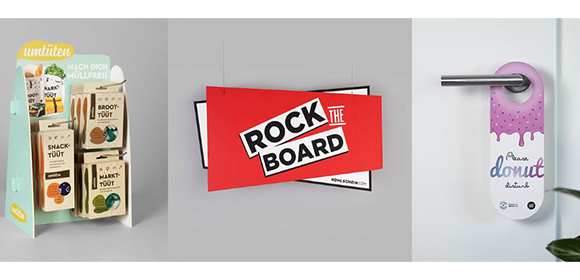
Kroma Display Board is a wood-pulp board developed as a sustainable alternative to the use of rigid plastic for internal POS and display. Its unique composition leads to excellent flatness and prolonged stability in changing atmospheric conditions. Fully recyclable in normal wastepaper streams, its double-sided, extra-smooth surfaces allow for excellent printing and converting.
In a number of common display scenarios, Kroma Board can be a highly competitive option on price while also delivering significantly improved sustainability credentials. That makes it an important example of how the industry can start to reframe the conversation.
Rather than asking, “Can we afford to choose the sustainable option?”, businesses should increasingly be asking, “Why are we still assuming the incumbent material is the most cost-effective?”
Why the perception persists
There are several reasons why misconceptions around sustainable materials and pricing still remain.
1. Market habits are hard to break
Foam PVC has been a go-to product in the sign and display sector for many years. Buyers, specifiers and end users know it well. It is often specified by default simply because it is what has always been used.
That creates inertia. Once a material is embedded in artwork templates, procurement lists and installer expectations, alternatives can be overlooked – regardless of whether they offer technical or commercial advantages.
2. Sustainability has too often been framed as a cost burden
The industry has spent a number of years discussing sustainability in terms of obligation, pressure and compliance. While those are all real factors, that framing can unintentionally reinforce the idea that sustainable choices are something businesses are forced to absorb as an added expense.
In reality, many sustainable innovations are now delivering genuine commercial benefits. The market needs to recognise that sustainability and competitiveness are no longer mutually exclusive.
3. Buyers are not always given full comparative information
Material decisions are often made quickly, especially for repeat applications. If buyers are not presented with side-by-side comparisons that include not only price but also sustainability, printability, conversion and disposal considerations, old assumptions can easily go unchallenged.
Sustainability and commerciality can coexist
Kroma Board demonstrates that lower-impact sheet materials can work in real-world production environments without requiring businesses to sacrifice cost-efficiency.
That matters because customers are becoming more sophisticated in how they assess sustainability claims. It is no longer enough to talk in vague terms about “greener options”. Print service providers and sign-makers increasingly need materials that are practical, scalable and commercially credible.
If a board can deliver a sustainable positioning aligned with customer expectations, reliable print and conversion performance, and a cost profile that competes with traditional materials, then the historic argument against switching becomes much weaker.
This is where the market is heading. Sustainability is becoming a standard business consideration, not a specialist add-on.
A wider industry conversation
There is growing recognition across the sector that legacy assumptions around material choice need to be challenged.
Chris Green, Visual Communication Director at Antalis, comments: “One of the biggest barriers to progress is not always product availability, but perception. Too many buyers still assume that choosing a more sustainable board means accepting a higher cost, when in many cases that is simply no longer true.”
The role of distributors and material specialists
Distributors have an important part to play in changing the narrative. Customers are often balancing multiple pressures at once: cost, turnaround, client expectations, technical suitability and environmental scrutiny. In that environment, they need more than just access to products, they need clear guidance.
By helping customers compare options properly and understand where sustainable alternatives can deliver equivalent or better value, distributors can support better decision-making across the supply chain.
This is not about suggesting that one material is right for every application. Foam PVC still has established uses in the market. But where a product such as Kroma Board can meet the performance requirements of the job while also offering strong sustainability advantages and competitive pricing, it deserves serious consideration.
Time to challenge outdated assumptions
The sign and display sector is under pressure to innovate, but innovation does not always have to mean higher costs. In many cases, it simply means being willing to revisit long-standing assumptions.
The belief that sustainable sheet materials are inherently more expensive than traditional alternatives is one of those assumptions, and it is becoming harder to justify.
Kroma Board is a clear example of how the market is changing. When compared with foam PVC in suitable applications, it shows that sustainability, performance and affordability can go hand in hand.
For sign-makers, printers and specifiers alike, the opportunity now is to move beyond outdated perceptions and evaluate materials on what they truly deliver. Because in today’s market, the most sustainable option may not be the costly alternative many still expect – it may simply be the smarter one.
Sustainable materials for your next Visual Communication project
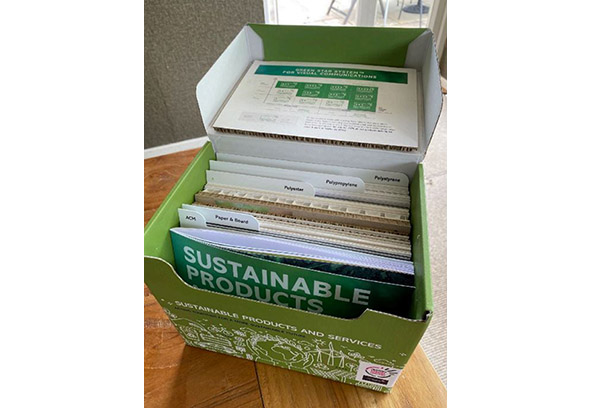
We are committed to providing a selection of more eco-responsible materials for your projects. With the Ecobox, we've curated the best alternatives for your main applications. We've organised these products into material type and provided printed samples with key features and benefits, print suitability and Green Star System rating.
This diverse range of products is designed to meet your customers' growing demands. Our goal is to provide you with a clear and transparent overview of available alternatives today. This enables you to identify and feel our products, making it easy to present them to your customers and guide them through the transition.